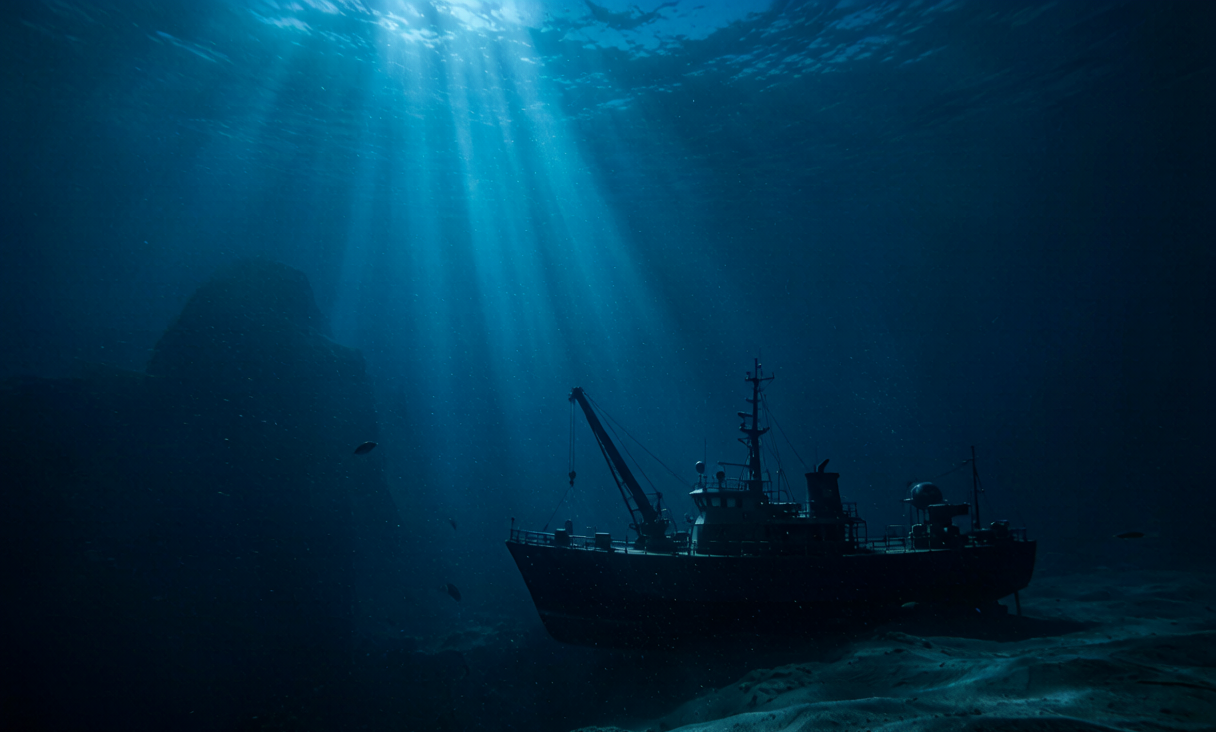
There is a particular sound the ocean makes in these games, and once you have heard it you do not forget it: the distant groan of something large moving in the dark, muffled by water, directionless. A wave of underwater survival games has crept up on players this year, and the setting is not incidental. The deep sea turns out to be almost perfectly engineered to produce the sensations the survival genre is built to deliver.
Why water works
Survival games run on a small set of verbs: gather, craft, endure. What separates a great one from a mediocre one is the texture of the threat. On land, danger is usually something you can see coming. In the water, danger is the medium itself. You cannot breathe it. You cannot see far through it. Sound travels through it in ways that confuse your sense of where something is. Every descent is a contract with your oxygen supply, and every contract has an expiration.
This gives designers a toolkit that land-based survival struggles to match. Verticality becomes a source of dread rather than navigation; down is where the light stops. Pressure becomes a mechanic, the deeper you go, the faster your resources drain, the bigger the things that live there. The unknown is not over the next hill. It is underneath you, right now, and you are swimming over it. The focus on environment-as-antagonist shares DNA with the design philosophy behind walking simulators, where the space itself tells the story.
The psychology of the deep
Players report a remarkably consistent emotional arc in these games, one that mirrors a real phenomenon: the ocean is beautiful and terrifying in roughly equal measure, and the two feelings reinforce each other. A coral garden lit by your flashlight is lovely; a coral garden lit by your flashlight while your oxygen timer ticks and something shifts at the edge of the beam is unforgettable. The genre has learned that beauty and dread are not opposites. They are partners.
"The scariest monster in an underwater game is the depth gauge. The number going up does the work that a hundred jump-scares cannot, because it is not attacking you. It is simply reminding you where you are."
There is also a practical reason for the setting's popularity that has nothing to do with psychology: it is forgiving to make. Water hides seams. It excuses low visibility. It lets a smaller team produce atmosphere that would demand a far larger budget on land. The deep sea is, in a sense, the genre's great equalizer.
Why now
It helps that the setting is generative rather than limiting. A forest is a forest; an ocean contains forests, and trenches, and reefs, and the open dark between them. The variety available to a designer willing to go deep is, for once, matched by the budget to render it.
Timing helps. After years of survival games set in forests and deserts, players and designers alike were ready for a setting that felt fresh. The ocean offered one, and it turned out to offer more than novelty. It offered a set of constraints that the genre had been quietly missing. The wave of underwater titles this year is not a coincidence. It is the medium discovering, again, that the oldest fear is often the most useful tool.