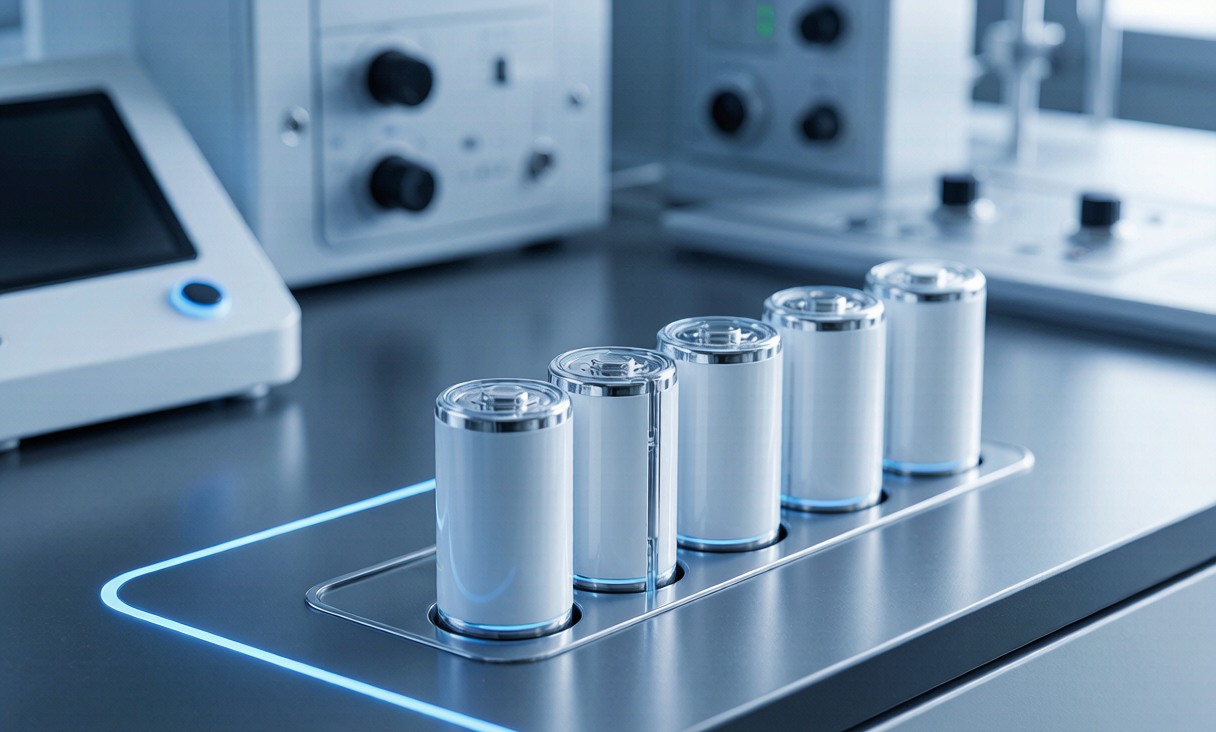
For the better part of a decade, solid-state batteries have been the technology that was always "five years away." This year, that joke finally stopped being funny for the skeptics: pilot production lines are running, the first cells are passing safety tests, and the question has shifted from whether solid-state will arrive to how fast it can scale.
What makes a battery "solid-state"
Conventional lithium-ion cells rely on a liquid electrolyte to shuttle ions between the anode and the cathode. It works well, well enough to put a supercomputer in your pocket, but the liquid is also the source of most of lithium-ion's headaches: it is flammable, it degrades over time, and it limits how much energy you can pack into a given volume.
A solid-state battery replaces that liquid with a solid electrolyte, usually a ceramic or a polymer. That single substitution cascades into a stack of advantages: the cell is far less likely to catch fire, it can theoretically hold more energy per kilogram, and it tolerates faster charging without the same degradation. In the lab, solid-state prototypes have hit energy densities that would embarrass today's best electric-vehicle cells. The same density gains that matter for vehicles are also reshaping edge devices, which increasingly need long-life power in compact form factors.
Why it's harder than it sounds
If the chemistry is so clearly better, why did it take so long? Because moving from a lab coin cell to a factory that can spit out millions of reliable units is a different sport entirely. Solid electrolytes are brittle; they expand and contract as the battery cycles, and maintaining contact between the layers at scale has been an engineering nightmare. Most of the last decade was not spent discovering the chemistry. It was spent learning how to manufacture it without the layers delaminating after a few hundred cycles.
"The chemistry was solved in principle years ago. What we've been solving since is the manufacturing, and that is the boring, expensive, world-changing part."
Cost is the other wall. Today's solid-state cells are still several times more expensive per kilowatt-hour than mature lithium-ion. That is fine for a satellite and impossible for a budget phone. The pilot lines now switching on are, in effect, betting that volumes will drive that cost curve down the same way they did for the lithium-ion cells these are meant to replace.
What it means for you
Do not expect a revolution next quarter. The first devices to use solid-state cells will be premium and priced accordingly, likely high-end wearables and a handful of flagship electronics, where the safety and density premiums are worth paying. Electric vehicles will follow, but only after the cost curve bends.
Still, the direction matters. A battery that charges in minutes, holds more, and is far harder to set on fire changes what hardware can be. And there is a second-order effect worth watching: a safer, denser cell changes product design itself. Thinner phones, lighter laptops, drones that stay aloft long enough to be useful, grid storage that finally makes economic sense. The broader climate technology landscape depends on exactly these kinds of storage breakthroughs. The headline number is the easy part to quote. The real story is how many other constraints quietly loosen once batteries get better.